$ Windows and Doors Blog | Chicago Exterior Remodeling Blog - WindowWorks

WindowWorks Blog

Energy Star 2026 Standards: What the Newest Federal Efficiency Requirements Mean for Your Upcoming Renovation

The landscape of residential energy efficiency is shifting rapidly, guided by updated federal benchmarks designed to reduce carbon footprints and lower utility costs for homeowners. As the Environmental Protection Agency (EPA) and the Department of Energy (DOE) continuously refine their guidelines, the fenestration industry—encompassing windows, doors, and skylights—must adapt to increasingly stringent performance criteria. For property owners planning an exterior home remodeling project, understanding the trajectory toward the Energy Star... Read More

The ROI of Replacement: Calculating the Payback Period for Energy-Efficient Windows

Homeownership requires strategic financial planning, particularly when managing recurring expenses like utility bills. For properties in the Midwest, maintaining a comfortable indoor climate year-round demands significant energy consumption. Evaluating the return on investment (ROI) for major exterior property improvements is a standard practice for property owners looking to optimize their monthly budgets. One of the most effective upgrades a property owner can make to minimize thermal transfer and reduce reliance... Read More

Gas Fills 101: Argon vs. Krypton—Which Invisible Gas is Best for Insulating Your Home?

Gas Fills 101: Argon vs. Krypton—Which Invisible Gas is Best for Insulating Your Home? Modern fenestration technology has advanced significantly beyond the single-pane glass of the past. Today, homeowners looking to improve the thermal performance of their properties often turn to high-performance replacement windows that feature insulated glass units (IGUs). Within these multi-pane systems lies a critical, yet entirely invisible, component: gas fills. When investigating the features of energy-efficient windows,... Read More

Low-E Glass Explained: How a Microscopic “Silver Shield” Keeps Heat Inside During Winter and Outside During Summer

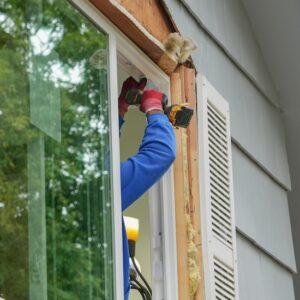
Workers installing new energy-efficient windows in a house
When selecting new residential glazing options, property owners frequently encounter the term "Low-E." While standard clear glass offers visibility and basic protection from the elements, it is highly inefficient at controlling the transfer of thermal energy. Low-emissivity, or Low-E, glass is engineered to minimize the amount of infrared and ultraviolet light that passes through the glass without compromising the amount of visible light entering the home. This microscopic metallic layer... Read More

U-Factor vs. R-Value: A Simple Guide for Chicago Homeowners to Understand Window Insulation Ratings

Decoding Window Insulation for Chicago Weather Chicago residents understand that the local climate presents unique challenges for maintaining a comfortable and energy-efficient home. With freezing, wind-driven winters and hot, humid summers, the thermal performance of a house is constantly tested. A significant portion of a home's thermal boundary consists of glass, making Chicago replacement windows a critical component of property maintenance and climate control. However, navigating the technical specifications of... Read More

Thermal Imaging 101: A Visual Guide to Where Heat Escapes and How New Windows Warm Up Walls

Understanding building performance requires looking beyond what is visible to the naked eye. In residential structures, temperature regulation depends entirely on the integrity of the building envelope—the physical separator between the conditioned and unconditioned environment. When energy bills rise and certain rooms become noticeably colder during the winter months, property owners often struggle to locate the exact source of thermal loss. Infrared thermography provides a scientific method to visualize these... Read More

Arctic-Grade Vinyl: Engineering Windows for Chicago’s -20°F Polar Vortexes

The Chicagoland area is renowned for its intense winter weather, frequently experiencing severe temperature drops associated with polar vortexes. When temperatures plummet to -20°F or lower, residential building materials face immense physical stress. Exterior fenestration systems—specifically windows and doors—are highly vulnerable to these extreme fluctuations. However, advancements in material science and polymer engineering have led to the development of arctic-grade vinyl compounds specifically formulated to withstand brutal winter conditions. Standard... Read More

The “Ice on the Inside” Mystery: Explaining Why Condensation Turns to Frost on Old Frames and How to Stop It

Homeowners waking up on a freezing winter morning often encounter a puzzling and frustrating sight: a layer of frost or ice forming on the inside of their windows. When the heating system is running and the interior is warm, finding frozen condensation inside the home can feel contradictory. However, this common winter phenomenon is firmly rooted in the principles of thermodynamics and building science. Understanding the interaction between indoor humidity,... Read More

Triple-Pane vs. Double-Pane: Is the Third Layer of Glass Worth It for Illinois Winters?

The severity of an Illinois winter presents unique challenges for residential properties, characterized by dramatic temperature plummets, freezing winds, and heavy snowfall. Maintaining comfortable indoor temperatures while managing utility costs requires robust architectural solutions, primarily regarding the building envelope. Windows represent a significant portion of a home's exterior and are historically responsible for substantial thermal transfer. Upgrading residential glazing is a primary strategy to create an energy-efficient Chicago home. For... Read More

Freeze-Thaw Fatigue: Why Chicago’s Rapid Temperature Swings Cause Window Seals to Fail Faster Than in Other Cities

Homeowners in the Midwest are no strangers to unpredictable weather patterns, but the specific meteorological conditions in the greater Chicago area present a unique challenge for exterior building materials. The localized climate is heavily influenced by Lake Michigan and the region's exposure to volatile continental air masses. This creates an environment where temperatures can shift drastically within a single 24-hour period. While these rapid barometric and temperature fluctuations are a... Read More

Subscribe to WindowWorks's Blog

Get WindowWorks's latest articles straight to your inbox. Enter your name and email address below.

This field is for validation purposes and should be left unchanged.

Headquarters

1060 N Garfield Street, Suite 600

Lombard, IL 60148